
Review: Pallida Cavtat ‘La Distanza Tra Noi E La Riva’
Amerigo Verardi, a leading figure in Italy’s independent underground rock scene, has reinvented himself over the years not only as a musician and singer-songwriter, but also as artistic director and driving force behind Apulian independent label NOS Records.
Founded in Lecce in 2021 by musician and producer Marco Ancona and journalist and radio host Mimmo Pesare, the label has released more than 50 records, becoming an important reference point for Italian independent music.
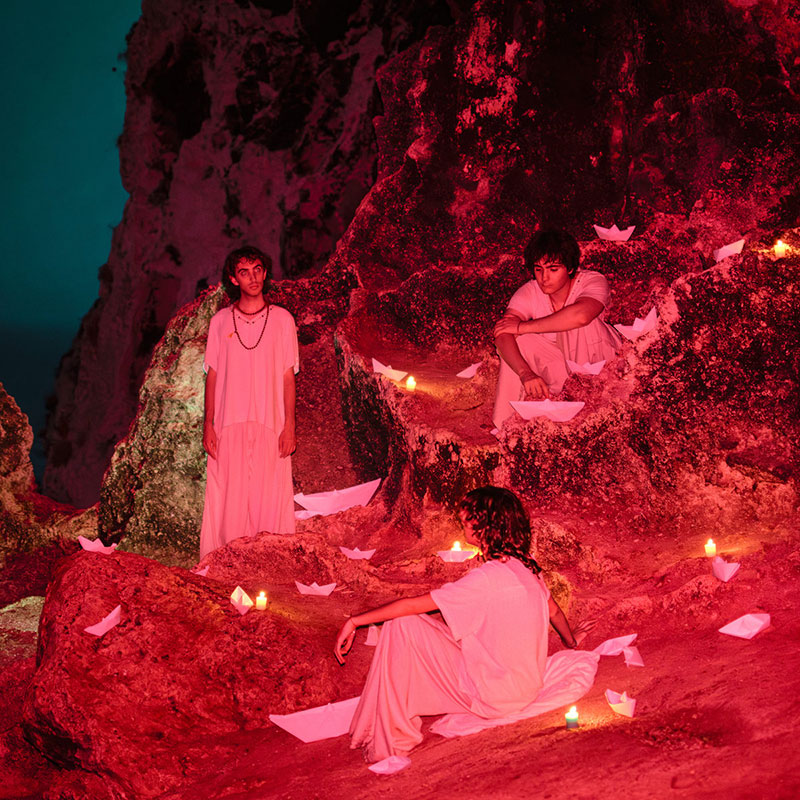
Following the success of this year’s impressive psych cinematic album A Deep Dive In The Colourful And Mysterious Garden Of Mr. Taxology by Taranto young duo Taxology, NOS now turns its attention to Lecce-based Pallida Cavtat (Pallida translates to Pale while Cavtat refers to the beautiful Croatian coastal town), an eclectic young power trio whose debut album, La Distanza Tra Noi E La Riva (The Distance Between Us And The Shore), offers another intriguing glimpse into Apulia’s restless underground creativity.
Formed in late summer 2024, this trio of young multi-instrumentalists formed by long-time friends Virginia Massi, Alberto Ruberti and Lorenzo Paiano, came together with a simple but ambitious goal: to make music, discover themselves through the creative process, and connect with those who lend an ear. Their spontaneous, abstract lyrics reflect inner states, fleeting thoughts, the beauty of the Salento’s Adriatic Sea and the world around them.
Although they cite influences including Blonde Redhead, Sonic Youth, Yuppi Flu and Verdena, their music feels distinctly personal. After three impeccable singles, they now present a debut that captures the formative stage of a band still exploring its identity while already developing a distinctive voice. As Massi explains, the album is ‘a sort of synthesis of our first year as a band’: eight of their strongest songs written between September 2024 and September 2025, followed by almost another year spent recording them.
What strikes me most is the energy. Pallida Cavtat sound like three people discovering what a power trio can do without worrying too much about whether every idea fits neatly into a genre. Alternative and post-punk elements collide with atmosphere, repetition, melody and experimental noise, yet there is always a genuine pop instinct underneath. A memorable guitar riff or vocal line becomes even more powerful when surrounded by chaos.
There is also a compelling contrast between delicacy and roughness. The music can seem tender one moment and almost aggressive the next, giving some songs a vaguely adolescent quality; not immature, but emotionally immediate, impulsive and unwilling to hide behind intellectual distance. Their enthusiasm is wonderfully raw. Their beauty lies in the way they approach each piece as a small laboratory of sound. Rather than relying on a fixed formula, the musicians seem to discover the character of each track as they go, with instruments entering, receding and colliding until the music reaches its maximum intensity.
The vocal interplay adds greatly to this movement, while shared between Massi and Ruberti, it’s Massi’s warm, radiant voice that provides much of the album’s emotional centre. Her delivery can be intimate and reassuring, yet there is always tension beneath its softness. Ruberti’s more angular, restless voice offers a useful counterweight, extending the emotional palette from tenderness to abrasion.
Alternative and post-punk elements collide with atmosphere, repetition, melody and experimental noise…
It would be unnecessary to discuss every track individually, but Freccia Rossa (Red Arrow) deserves particular attention for its understated beauty. Fluid guitar touches and direct, unembellished drumming create something quietly cinematic, showing that restraint can be as expressive as noise. That balance becomes more volatile on Enoch, where delicacy and roughness continually rub against each other.
Built around a distinctly post-rock sensibility, the track combines Ruberti’s Italian-and-English vocals with spoken-word passages from Lucio Ennio Caprioli, it moves from tenderness towards near-aggression without ever feeling arbitrary. The instability is precisely what gives it character. Estrogeni (Estrogens) offers a different kind of intimacy, its warm and delicate sound creating a softer space within the album.
Yet the experimental instincts remain, particularly in Incendio/Accordi (Fire/Chords). The ethereal passages gradually give way to brilliantly noisy textures, which is not simply for effect, but another part of the band’s vocabulary, leaving the track suspended somewhere between composition and improvisation.
Then comes Il Motivo Per Cui Non Sarò Un Pianeta (The Reason Why I Won’t Be A Planet), an ending that feels almost inevitable in retrospect: a meeting point between the album’s melodic and experimental impulses. Massi’s soft bass chords sit beneath Paiano’s light, precise drumming, creating an atmosphere of unusual fragility before expanding into a duet as melody and rage coexist rather than cancel each other out. Eventually, even this expansive beauty dissolves into extreme experimental noise, as if the album’s accumulated tension can no longer be contained by melody.
What makes the ending particularly effective is what follows: the voices of the members themselves, speaking with the unmistakable satisfaction of having finally arrived somewhere following a long and surreal journey. After all the textures, ruptures, melodies, noise and emotional turbulence, the record ends not with a grand statement, but with the feeling of people looking back at what they have created and thinking: we made it.
It was quite an adventure, even surreal, as that sense of journey ultimately defines Pallida Cavtat. Their sound comes from a band having a blast, discovering what they can create together, and that passion comes through loud and clear to those lucky ears. And yes, that is exactly what I would call an enthusiastic debut.
Label: NOS Records
Band Links: Bandcamp | Spotify | Instagram
Scribed by: Domenico ‘Mimmo’ Caccamo